
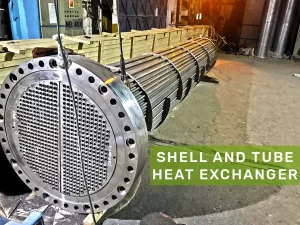
Let’s Talk About Shell and Tube Heat Exchanger
The heat exchanger is used for transferring heat from one medium to another medium. A heat exchanger acts as a cooler or warmer for a fluid and it can be used in many different applications such as power plants, refrigeration systems, air conditioning, and heating systems, mining systems, and food industries. Today many of the industries are even using waste heat recovery systems in boilers which also serve the purposes of heat exchanging between two systems for example, the outlet of the boiler is connected with the economizer to enhance the overall efficiency of the boiler. Hence, heat exchangers are very beneficial for any industry. The Shell & Tube Heat Exchanger is a solid-wall heat exchanger with a proper shell and tube-type structure. It operates with a top and bottom loop of tubing and has two fluid passages through the core. This design allows heat transfer without an intermediate step in between the heat source and multiple destinations, making it more efficient than other types of heat exchangers. Classification of Heat Exchangers by Flow Configuration Cocurrent Flow In cocurrent flow type heat exchanger, the streams flow parallel to each other and in the same direction. This is less efficient than countercurrent flow but does provide more uniform wall temperatures. Cross Flow Crossflow heat exchangers are intermediaries in efficiency between countercurrent flow and parallel flow exchangers. In these units, the streams flow at right angles to each other Countercurrent Flow Countercurrent flow exchanger is one in which the two fluids flow parallel to each other but in opposite directions. This type of flow of arrangement allows the largest change in temperature of both fluids and is therefore most efficient. Cross/Countner Flow In counter flow type of heat exchanger, the two fluids flow parallel to each other, but in opposite directions. Why Baffles Are Used In Shell and Tube Heat Exchangers? ✔️ To support the tube✔️ To direct the fluid stream across the tube✔️ To improve the rate of heat transfer Advantages of Heat Exchanger ✔️ High Efficiency✔️ High operating pressures✔️ More heat transfer between the different sources✔️ Less Costly than others Limitations of Heat Exchanger ✔️ Large size✔️ More space is needed for cleaning✔️ Difficult to clean Shell Side Heat Exchanger Problems 1. Heat Exchanger Fouling Fouling is the formation of unwanted material deposits on heat transfer surfaces of tubes during process heating and cooling. Fouling might contain materials that consist of either living organisms or non-living organisms. Types of Fouling ✔️ Incrustation✔️ Scaling✔️ Sediment✔️ Biological Growth Reasons of Fouling ✔️ Variable water pH ✔️ Product viscosity ✔️ The Roughness of component surfaces Solutions ✔️ Using cleaning agents for removing the scaling and incrustation ✔️ Removing sediments ✔️ Using a chemical cleaning process or water treatment method to remove biological growth 2. Corrosion Corrosion is the gradual deterioration of metals caused by the action of air, moisture, or a chemical reaction (such as an acid) on their surface. Solution Selecting the material with adequate corrosion resistance for the environment along with using proper treatment chemicals. 3. Vibration Heat exchangers should not be placed near equipment such as air compressors or mechanical chillers because excessive vibrations from these machines can cause tube failures. Conclusion Shell and tube type heat exchangers are used widely in the industrial market and are the most commonly available heat exchangers within the markets due to the high demands. Also, the maintenance of these heat exchangers is very easy compared to the other heat exchangers. Solarkaz International is providing the best solution for Heat Exchangers throughout the markets, which is valuable in regard to the total cost of ownership. We had several clients all over the world, and we are competent in building Heat Exchanger designs as per International Standards. Looking for the Heat Exchangers? Contact us to know more about the Heat Exchangers.
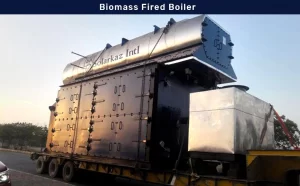
Everything You Need to Know About Biomass Boiler
Biomass which is the renewable energy source of organic material is now an emerging source of fuel used worldwide for power boilers. Advantages of Biomass As Fuel Biomass can be used for several industrial and domestic purposes as well as is useful as boiler fuel. Biomass is being used as an effective alternative to traditional coal, petroleum coke or oil, and gas fuels. Biomass has a low impact on the environment compared to conventional fossil fuels. This type of energy production has a limited long-term effect on the environment because the carbon in biomass is part of the natural carbon cycle, while the carbon in fossil fuels is not, and does not permanently adds carbon to the environment as compared to the burning of conventional fuels. Some of the advantages of Biomass fuel in boilers are as follows: Environmentally friendly, non-polluting, and non-hazardous fuel Produces low Carbon footprints Widely available Produced and degraded easily as compared to the availability of oil and gas reserves which are being depleted at the faster pace Less expensive. Types of Biomass Fuels Biomass fuel is produced from a wide range of materials. These burning fuels include wood, agricultural residues, animal manure, and organic wastes from households and industries. Want to Know About Biomass Boilers? Biomass boilers are very similar to gas boilers but use several types of organic compounds like Biomass Pellet, wood, Waste Cloth, Rice Husk, Peanut Shell Bagasse, Bamboo Chip Mustard Stalk, Wood Chip, cotton seed, corn cob, Cotton Stalk, etc. as fuel sources. The conventional life cycle of working of biomass boilers employs: The sources of fuel are first converted to pellets. These pellets are then transported to the industries for feeding into the biomass boilers. The pellets are fed into the automatic feed hopper of the biomass boiler which stores pellets and feeds them into the boiler when needed. After combustion of the fuel, the fuel ashes are accumulated into the ashtray from where they are removed as per the instructions of the boiler manufacturer. Wrong Perception Some people have the idea that biomass boilers are labor intensive, due to the traditional perception of how they work. In the past, people thought that they needed to fill up the boiler every day and clear it out occasionally to ensure that it worked properly. This is no longer the case with modern biomass boilers, as they can provide clean, efficient, and technological solutions for the needs of the modern world. But still safety and prevention of boilers is necessary in terms of its use, because if the boilers are not properly maintained and cleaned there exists a chance of boiler eruption which could be catastrophic. This is no longer the case with modern boilers and biomass boilers, as they can provide clean, efficient, and technological solutions for the needs of the modern world. Being Futuristic Nowadays, biomass boilers are engineered in a way to reduce labor while providing a fully automated system of feeding, bed functioning, exhaust gas emissions, and fan-forced or natural draft mechanism as per international standards and provide space flexibility for various fuels within the feeding chamber of the boiler. Solarkaz International has expertise in manufacturing biomass boilers which could provide all of the above features with a fully automatic control system and additional safety and reliability. Our aim is to provide a quality product to our clients at economical prices. Looking for the Biomass Boilers? Contact us to get FREE enquiry about Biomass Boilers.